Audi Sport Quattro S1
Front-engine fury, five-cylinder thunder, and the last true king of Group B.

Calreyn88 · CC BY-SA 4.0
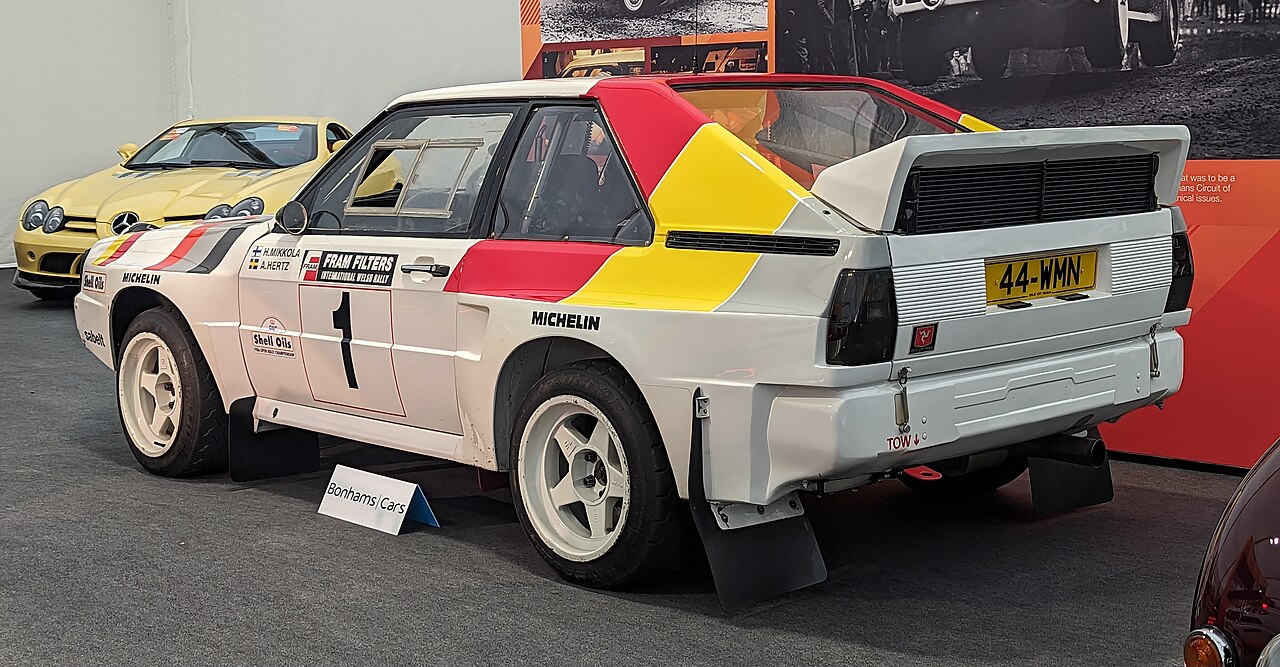
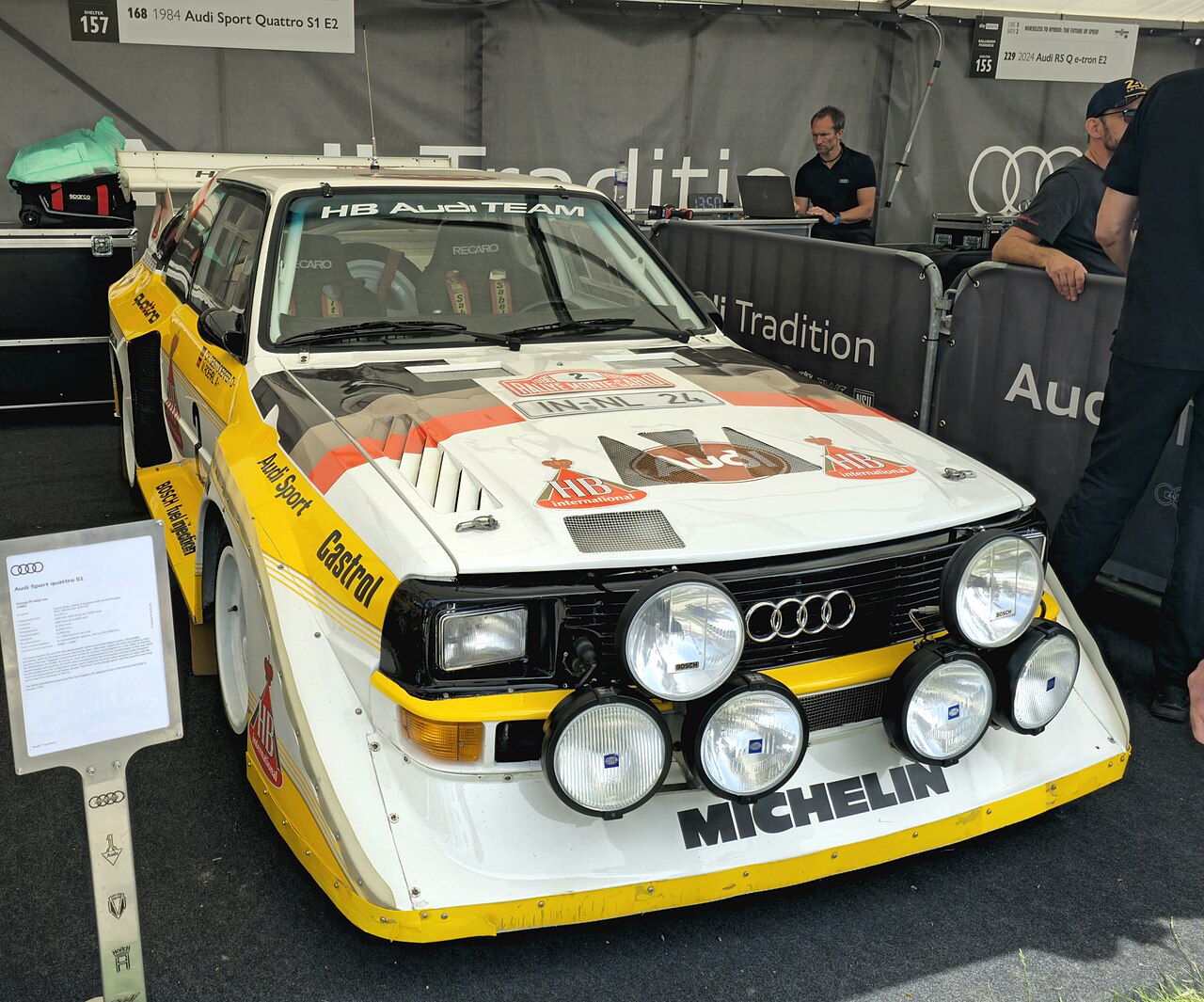
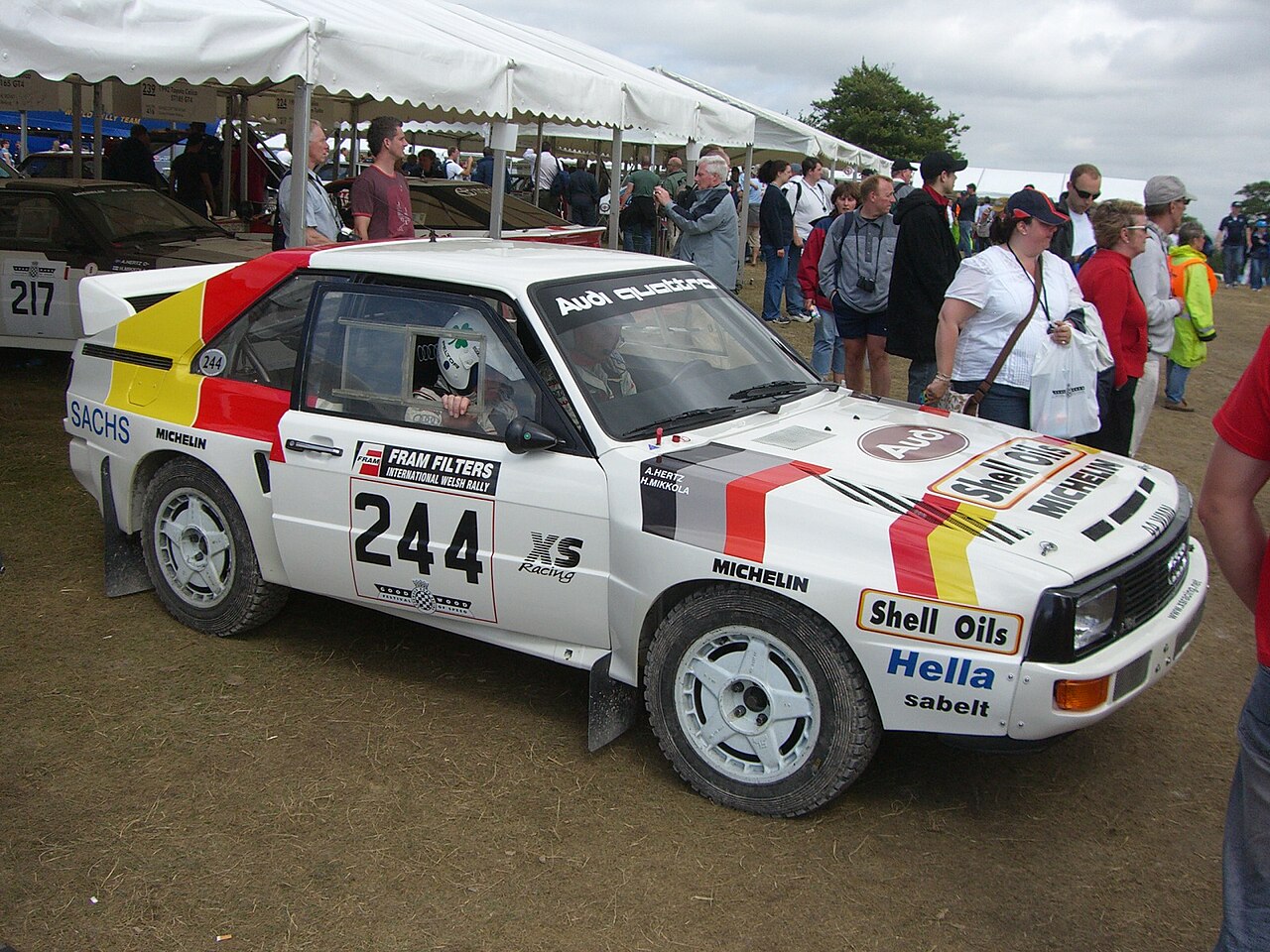
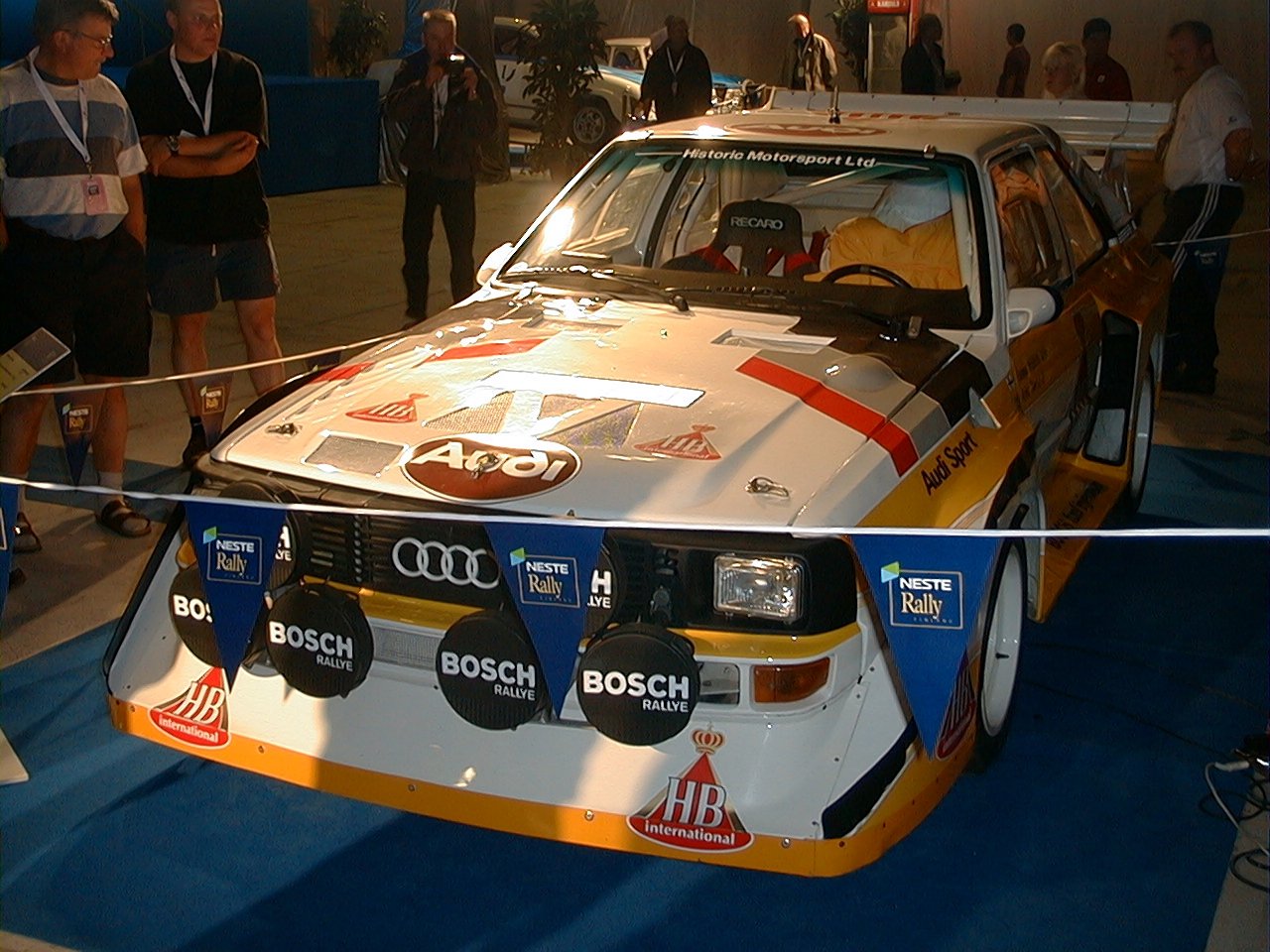
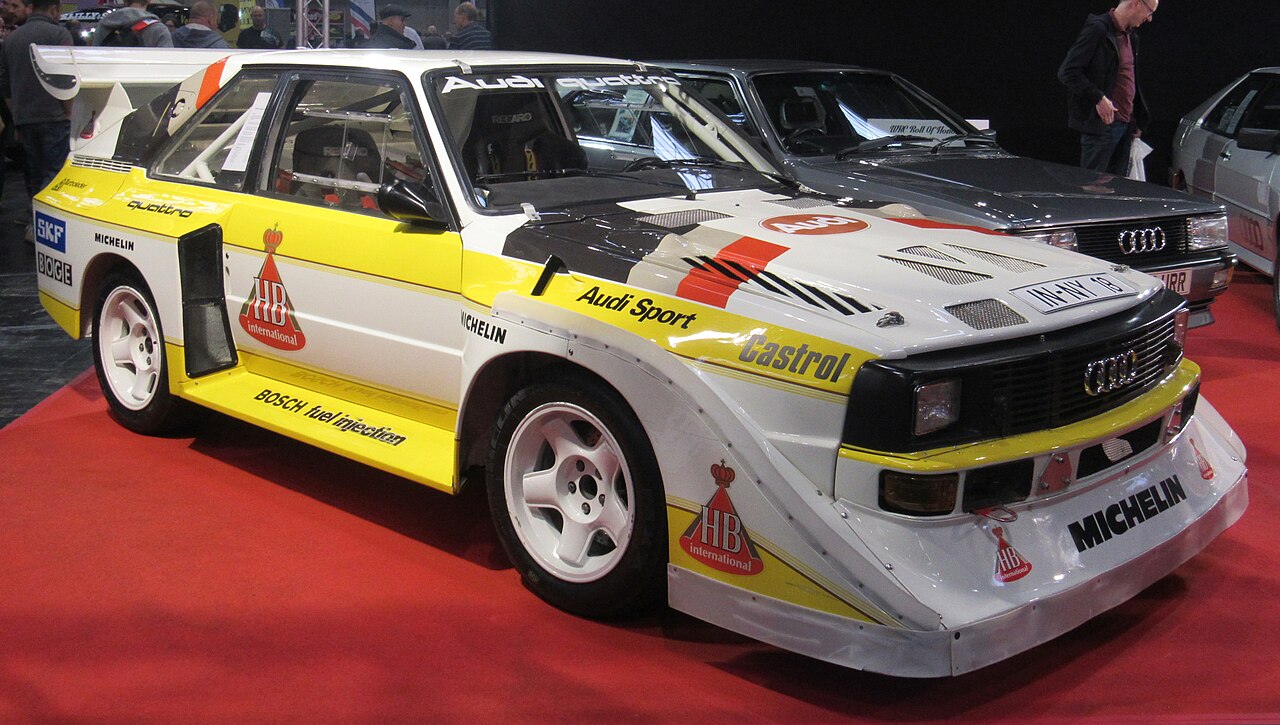
The Audi Sport Quattro S1 was the apex of Audi's Group B rally programme and one of the most formidable machines ever to compete in the World Rally Championship. Evolved from the shorter, wider Sport Quattro homologation special, the S1 carried a turbocharged five-cylinder engine up front in a front-engined, all-wheel-drive layout that gave it a ferocious combination of power, traction, and agility. Its aggressive, wedge-shaped bodywork with enormous side intakes made it instantly recognisable and unmistakably menacing on any rally stage. Although Walter Röhrl drove the S1 to several wins, the 1985 World Rally Championship Drivers' title was won by Timo Salonen; Audi did secure the Manufacturers' title that year. Supported by a deep bench of factory drivers including Stig Blomqvist and Hannu Mikkola, the car represented the absolute peak of Group B's 'anything goes' philosophy before the category was retired after 1986 for safety reasons.
- Layout
- Front-engined, all-wheel drive
- Major Honour
- 1985 WRC Manufacturers' Champion
Lore & Background
Audi's entry into rallying with the original Quattro in 1982 had already shocked the motorsport world by proving that a production-based, all-wheel-drive, turbocharged car could compete at the very top. The Sport Quattro of 1984 sharpened that message with a shorter wheelbase and wider track, but the S1 was the uncompromised evolution: a purpose-built Group B weapon with a dramatically reworked chassis, a more powerful turbocharged five-cylinder, and a body that looked as though it had been carved from a single sheet of aluminium by someone who had never apologised for anything. The 1985 season became a statement. Röhrl's precise, metronomic style married perfectly with the S1's raw mechanical grip, and Audi swept the Manufacturers' championship with a confidence that left rivals scrambling, though the Drivers' title went to Timo Salonen. The car's front-engine placement gave it a weight distribution and turning behaviour that mid-engined rivals could not easily match, particularly on the tight, twisty forest stages of Europe where the S1's agility was most lethal. By 1986, the S1 E2 evolution pushed the power further still, but the broader Group B category was already in decline. A string of fatal accidents across the championship's various disciplines led the FIA to axe Group B after the 1986 season. The Audi Sport Quattro S1 thus stands as the final, blazing exhalation of an era when rallying was untamed, unregulated, and absolutely terrifying to watch.
In Their Own Story
The forest stage at 6 a.m. was all mist and diesel. Röhrl sat in the S1's cockpit, the five-cylinder idling with a low, guttural growl that vibrated through the steering wheel and into his palms. The co-driver called the first note—'left, left, right, crest'—and Röhrl dropped the clutch. The turbo spooled with a half-second delay, then the car lunged forward like a held breath finally released. Gravel sprayed in a white fan behind the rear wheels. The mid-engine weight shifted, the car rotated on its haunches with a precision that felt almost mechanical, almost inevitable. He could feel the turbo's pulse in the cabin, a rhythmic throb against the back of his skull. The next corner was a hairpin through birch trunks so close he could see the bark. He didn't lift. He never lifted. The S1 slid, corrected, and roared on into the fog, and somewhere behind him, the sound faded into nothing but the creak of trees and the distant, indifferent silence of the Swedish morning.
Reader's Guide
The Audi Sport Quattro S1 defined the 1985–1986 window of the WRC's Group B era, a period when the FIA's regulations allowed manufacturers to build essentially purpose-bred rally cars with minimal relation to their road-going counterparts. Audi's programme, run by Audi Sport, had already established the Quattro as a serious force in 1982–1983, but the S1 represented the category's logical endpoint: a mid-engined, all-wheel-drive, turbocharged five-cylinder rally car that combined the raw power of a sports car with the traction of a four-wheel-drive truck. The technical character was aggressive and uncompromising. The 2.1-litre inline-5, forced by a single turbocharger, delivered well over 350 horsepower in race specification, channelled through a close-ratio gearbox to all four wheels. The mid-engine layout placed the mass low and central, giving the S1 a turning radius and weight-transfer behaviour that front-engined rivals like the Lancia Delta S4 or the Peugeot 205 T16 struggled to replicate on tight European forest stages. Walter Röhrl was the car's definitive driver, his 1985 World Championship the programme's crowning achievement. Michèle Mouton, Stig Blomqvist, and Hannu Mikkola rounded out a factory line-up of extraordinary depth. The S1 E2 of 1986 added further power and refinement, but the category's cancellation after that season made the S1 the last word in an age of unregulated, breathtaking speed.
Did You Know?
- The S1's front-engine, all-wheel-drive layout was virtually unique in Group B, giving it a weight distribution and turning behaviour that mid-engined rivals could not easily match on tight forest stages.
- Michèle Mouton did not race the S1 in the 1985 WRC season; she had left Audi Sport after 1984 and did not compete as a factory driver for Audi that year.
- The Group B category was abolished after the 1986 season following a series of fatal accidents, making the Audi Sport Quattro S1 one of the last cars to compete under those now-infamous 'anything goes' rules.
Origins & Engineering Vision
The concept for a high-performance, four-wheel-drive Audi traces back to 1977, when chassis engineer Jörg Bensinger noticed that the Volkswagen Iltis military vehicle outperformed civilian cars in snowy test conditions. This observation, combined with Walter Treser's role as Director of Pre-Development, led to the development of an Audi 80 variant that would become the Quattro. The name itself is drawn from Italian, meaning "four," a deliberate nod to the fact that power reaches all four wheels. The original model is often called the Ur-Quattro, where the German prefix "Ur-" signals something primordial or first of its kind. Martin Smith was responsible for the car's distinctive flared wheel arches, giving it a muscular stance that set it apart from the standard Audi 80 Coupé (B2) on which it shared its platform and many components. Internally, Audi designated it Typ 85, a code it shared with the quattro versions of the Coupé line, and the car featured independent front and rear suspension throughout its life.
Rally Dominance & Regulatory Innovation
The Quattro made history by being the first rally car to exploit a newly revised set of competition rules that permitted four-wheel-drive systems. This regulatory shift opened a door that Audi walked through with remarkable speed, claiming consecutive competition victories over the following two years. For the rally variant, Audi made a precise engineering adjustment: the engine displacement was trimmed from 2,144 cc to 2,133 cc, a calculated move to fit within the 3-litre class when the 1.4 multiplication factor was applied. The competition engine was a DOHC inline-five with 20 valves, fed by a KKK K27 turbocharger spinning at 1.03 bars of boost and cooled through a Länger & Reich air-to-air intercooler. Bosch LH-Jetronic handled fuel delivery, and the whole assembly produced 225 kW (306 PS) at 6,700 rpm with 350 N⋅m of torque at 3,700 rpm. The success of this rally program cemented the "quattro" name as a permanent part of Audi's identity.
Production & Design Longevity
From its European debut in late 1980 until the final unit rolled off the line on 17 May 1991, the Quattro was partially hand-built on a dedicated production line, yielding a total of 11,452 cars. Remarkably, the exterior design remained largely untouched across those eleven years. The front grille evolved from four separate headlamp lenses to combined twin-reflector units by 1983, then received a sloping grille and revised trim for the 1985 "facelift" model. Inside, the changes were more frequent: a green LCD instrument cluster replaced the analogue dials in 1983, an orange LCD followed in 1988, and the dashboard, steering wheel, and center console were redesigned in 1984. The rear suspension was modified early on, with geometry changes and the removal of the anti-roll bar to curb lift-off oversteer. By 1987, a Torsen centre differential replaced the manual lock, and wheel sizes grew from 6x15 to 8x15 inches with Pirelli Cinturato P5 rubber.
Market Reach & Enduring Brand Identity
The Quattro's influence extended far beyond its own production run. To honor the original vehicle's competitive success, Audi adopted the lower-case "quattro" as a permanent badge for every subsequent model equipped with its four-wheel-drive system, transforming a single car name into a corporate trademark. In Europe, the car was the first to pair a front-engine, four-wheel-drive layout with a turbocharged powerplant, a combination that redefined what a production saloon could achieve. In North America, where sales began in the 1983 model year, the Quattro entered a market already shaped by the AMC Eagle's full-time automatic AWD and Subaru's optional part-time system on the Leone wagon. The 1989 20V RR variant pushed output to 162 kW (220 PS) with a top speed of 230 km/h, and added a three-spoke steering wheel, leather-trimmed interior surfaces, and a full-length leather-wrapped center console reaching the rear seats. The Quattro's production ended two years after the new Audi Coupé (8B) range arrived, marking the close of an era.
Gallery
Frequently Asked Questions
What is the Audi Sport Quattro S1?
It is the ultimate evolution of Audi's Group B rally programme, a purpose-built mid-engined, all-wheel-drive weapon for the mid-1980s WRC. It grew out of the Sport Quattro homologation special into a far more aggressive machine with a wedge-shaped body and enormous side air scoops.
What engine and drivetrain does the S1 use?
A 2.1-litre turbocharged inline-five sits behind the driver, feeding power through a full-time all-wheel-drive system. That mid-engine, AWD combination delivered exceptional traction and a remarkably agile balance on loose gravel and snow.
Which driver is most closely linked to the S1's championship success?
Walter Röhrl was the primary driver who carried Audi to the 1985 WRC Drivers' and Manufacturers' titles at the wheel of the Sport Quattro S1. His consistent, aggressive pace made him the definitive name associated with the car's dominance.
What major WRC titles did the Audi Sport Quattro S1 win?
In 1985 the S1 secured both the Drivers' and Manufacturers' World Championships for Audi. It remained a top-contending machine into the 1986 season before Group B was phased out of the regulations.
Why do fans regard the S1 as one of the greatest rally cars ever built?
It paired raw turbocharged five-cylinder power with a mid-engine, AWD layout that made it nearly impossible to slide out of control on the most treacherous stages. Its fearsome wedge silhouette and huge intakes made it as visually iconic as it was mechanically dominant, cementing its reputation as the last true king of Group B.
More in Cars & Manufacturers
Elsewhere in the World Rally Championship universe
Spotted an error? Know more?
This is a living reference — every entry is fact-audited, and reader corrections feed straight into our audit queue. Suggest an edit · See this site's audit record